

Sometimes, the problem isn't the quality of the campaign. It's the assumption that an idea which resonates in one market will automatically resonate in another.
For global marketing teams, this creates a familiar dilemma: should we adapt the global campaign or develop something locally?
It's a decision with implications for creative effectiveness, brand consistency, budgets and speed to market.
And it deserves more consideration than simply asking whether the existing assets can be localised.
Adaptation and local-first development solve different problems
Global campaign adaptation takes an existing central concept and adjusts its execution for another market.
This might involve language, imagery, cultural references, messaging or channel formats. The central idea remains intact, even if its expression changes.
Local-first campaign development starts with the needs, behaviours and cultural context of a particular market. The creative concept is developed around that audience rather than inherited from an existing global campaign.
Both approaches can deliver effective marketing.
The challenge is determining which gives the brand the strongest opportunity to connect with its audience.
And the answer isn't necessarily the same across every market.
When adapting a global campaign makes sense
Adaptation is often the right choice when the central campaign idea is relevant across markets, but its execution needs adjusting.
Consider a global consumer brand launching a product around convenience.
The underlying proposition may be equally meaningful to consumers in Germany, Denmark and the UK.
But the situations in which people value convenience, the language they use and the channels where they encounter the brand may differ.
The brand doesn't necessarily need three separate campaigns.
It needs a strong central idea supported by market-specific executions.
Adaptation is particularly effective when:
- The core consumer need is shared across markets.
- The central creative concept is understood and relevant locally.
- The product proposition remains consistent.
- Cultural differences can be addressed without changing the underlying message.
- The campaign offers enough flexibility for meaningful local execution.
The key question is whether the central idea remains relevant after the necessary local changes.
If it does, adaptation can protect creative consistency while reducing unnecessary duplication.
If it doesn't, the brand may be trying to preserve a concept that no longer serves the audience.
When creating locally is the better decision
Sometimes, the challenge goes beyond language, imagery or execution.
The audience may have different motivations. The competitive landscape may be fundamentally different. Or the global concept may rely on cultural assumptions that don't translate.
Imagine a campaign built around a particular national tradition, sporting reference or style of humour.
Those elements might be central to why the campaign works in its original market.
Replacing them with local equivalents sounds straightforward. But if the emotional appeal depends on the original context, the result may feel forced.
In this situation, creating locally may be more effective than repeatedly modifying the global execution.
Local-first development deserves consideration when:
- Consumer motivations differ significantly from those behind the global campaign.
- Local competitors have changed how the category is perceived.
- The central concept depends heavily on culturally specific behaviour or humour.
- The product has a different role or use case in the market.
- Regulatory requirements fundamentally change the message.
- A strategically important market requires a distinct approach.
This doesn't mean abandoning the global brand.
It means developing a creative solution that respects the brand's positioning while responding to local realities.
Brand consistency should come from shared principles, not identical executions.
Five questions to help you make the decision
Rather than treating adaptation and local-first development as opposing philosophies, global marketing teams can evaluate each campaign against five questions.
1. Is the underlying audience need the same?
Start with the audience, not the creative assets.
What problem is the campaign addressing? What motivates the audience to act? Is that motivation equally relevant in the target market?
A shared product benefit doesn't always mean a shared purchase motivation.
The same product might be purchased for convenience in one market and affordability in another.
Decision: If the audience need is consistent, adaptation is a strong starting point. If it differs substantially, explore local-first development.
2. Does the central creative idea make sense locally?
A campaign can be technically translatable without being culturally meaningful.
Humour, symbolism, social conventions and storytelling influence how creative work is received.
Ask local teams whether the concept feels natural, relevant and credible, rather than simply whether they understand it.
Decision: If the idea resonates locally, adapt the execution. If making it relevant requires rebuilding the concept, consider creating locally.
3. How different is the competitive environment?
A global brand may be an established category leader in one market and a relatively unfamiliar challenger in another.
In the first, the campaign might reinforce preference. In the second, it may need to establish awareness or explain why the brand deserves consideration.
Identical messaging could miss these different objectives.
Decision: If the competitive challenge is similar, adaptation may work. If the market requires a different strategic response, local development may be justified.
4. Can the existing campaign accommodate meaningful adaptation?
Not every global campaign is designed with localisation in mind.
Some concepts depend heavily on specific photography, wordplay, celebrity partnerships or tightly integrated visual and verbal elements.
Before committing to adaptation, assess how much flexibility exists.
Can the imagery change? Can the message be rewritten? Can local teams select different formats or channels?
Decision: If the concept has sufficient flexibility, adapt it. If the required changes undermine the concept itself, consider a local approach.
5. What is the commercial case?
Creative relevance matters, but so do time, budget and operational complexity.
Local-first development may require additional research, concept development, approvals and production.
Adaptation can reuse existing assets, although extensive adaptation isn't automatically inexpensive.
A strategically important market with significant growth potential may justify greater creative investment than one with a straightforward campaign objective.
Decision: Choose the approach with the strongest expected outcome for the investment, not simply the lowest initial production cost.
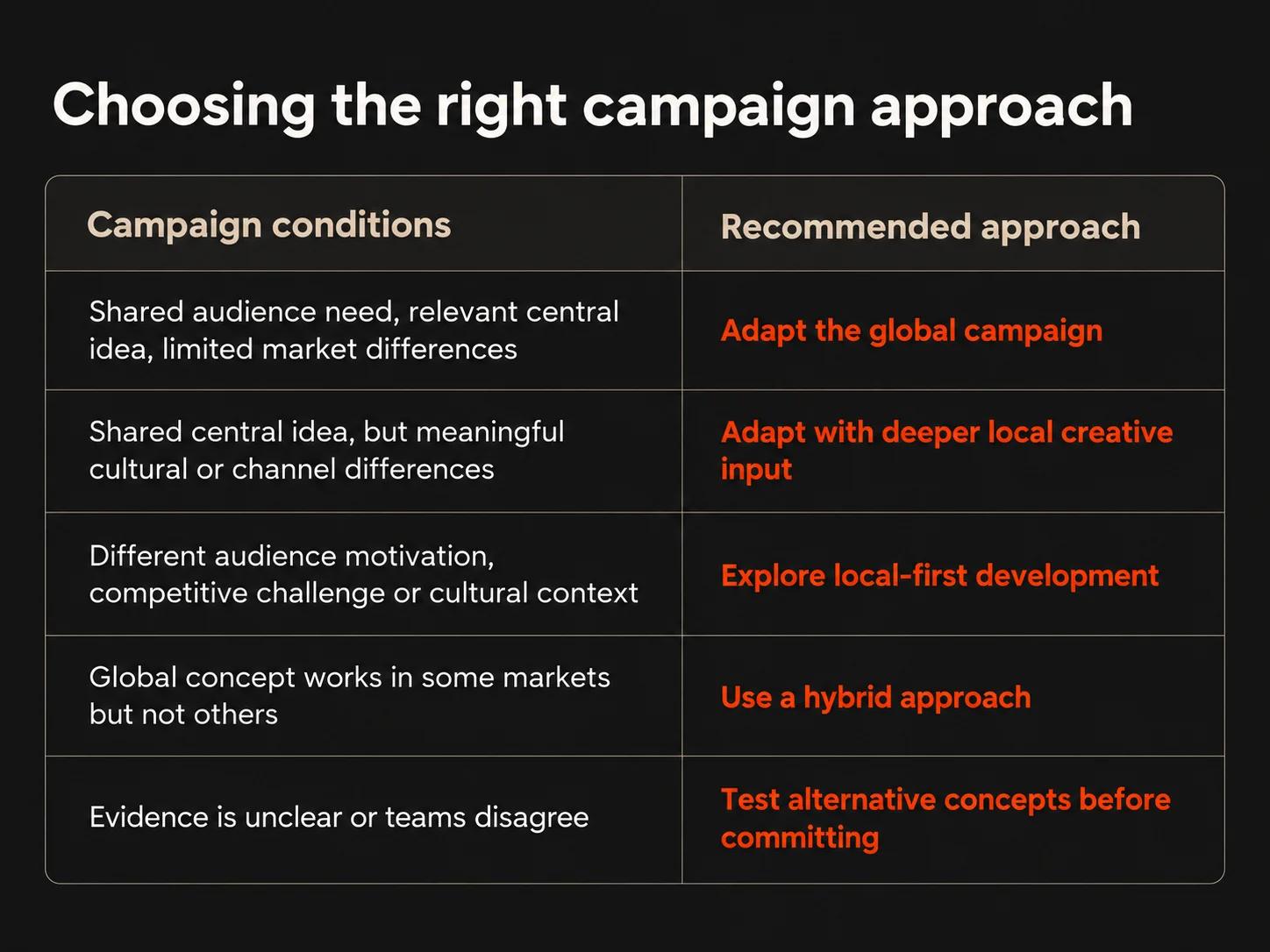
A practical decision framework
These five questions can be brought together into a simple working model.
The overlooked option: A hybrid approach
One mistake global marketing teams can make is assuming they must choose one approach for every market.
In practice, a hybrid model can be more effective.
The global team defines the brand platform, campaign objectives and elements that must remain consistent.
Regional and local teams then determine how those principles should be expressed.
Some markets may use lightly adapted versions of the global campaign.
Others may need substantially reworked executions.
A smaller number may benefit from locally developed concepts that support the same overarching brand strategy.
The important distinction is between what the brand stands for and how it communicates it.
Those don't always need to be identical.
Make the decision before production begins
Changing direction late can be expensive.
Imagine a global team has already produced the hero film, photography, social assets and supporting content.
Only then does a regional team explain that the central concept doesn't resonate locally.
The options are now limited: rework the assets, accept a weaker execution or commission new creative under time pressure.
A better process brings local insight into campaign planning before the central concept is finalised.
That doesn't mean every market needs to participate in every decision.
It means identifying potential barriers early enough to make informed choices.
A practical process involves:
- Defining global non-negotiables: Establish brand principles, objectives and elements that must remain consistent.
- Gathering local insight: Understand audience motivations, cultural considerations and competitors.
- Assessing the creative concept: Identify which markets can use the central idea and which need a different approach.
- Agreeing the development model: Decide where to adapt, where to create locally and who approves what.
- Planning production accordingly: Build assets, timelines and workflows around those decisions.
This reduces avoidable rework and gives local teams a clearer role in campaign development.
How do you know whether you made the right decision?
Success shouldn't be judged solely by whether the campaign launched on time or whether every market used approved assets.
Those are operational measures, not proof of creative effectiveness.
Evaluate results against each market's objectives.
Depending on the campaign, this might include awareness, message comprehension, consideration, engagement or conversion.
Where possible, compare different approaches through creative testing rather than relying entirely on subjective preferences.
It's also worth reviewing the operational impact.
How much rework was required? Were approval cycles efficient? Did local teams have the flexibility they needed?
These insights can help improve future global campaign decisions.
The goal isn't maximum consistency. It's effective consistency.
Global marketing needs consistency. Without it, brands risk fragmentation and unnecessary complexity.
But consistency becomes counterproductive when it prevents a campaign from connecting with the audience.
Equally, creating everything locally can waste resources and weaken the benefits of a shared brand platform.
The strongest approach protects the strategic elements that make the brand recognisable while allowing creative execution to respond to local realities.
For global marketing teams, the question shouldn't simply be, Can we adapt this campaign?
It should be:
Will adapting this campaign deliver the right result for this market, or would we achieve more by creating something locally?
That's a better starting point for making global ideas work wherever they need to go.