

WHAT WE DO
OUR WORK
ABOUT US
GET IN TOUCH →
Are we all just acting?



Following on from the movie awards season, and coinciding with several events, pitches and conferences for myself, I was struck by the thought that much of the behaviours in business development share similarities with acting.
Both actors and business developers consciously shape how they are seen, drawing on the same underlying dynamics of performance, impression management and emotional labour.
Taking a lead from the phrase ‘All the world’s a stage’ you can easily swap a stage for a pitch presentation, a movie scene for an introductory client call, or a pre shoot read through for a business planning meeting.
It was Erving Goffman, sociologist, social psychologist and writer who coined the phrase ‘everyday life is theatre’ back in the 1950s. He promoted the view that people perform roles for specific audiences, using scripts, costumes and settings to manage how others perceive you, avoid embarrassment and make a positive impression. He went even further, drawing from the world of acting to break the theory down into:
- Front Stage: the place where individuals perform, adhering to conventions and roles (e.g at work) for an audience.
- Backstage: the private area where individuals step out of character, relax, and prepare for future front-stage performances.
- Impression Management: the conscious or subconscious, and often calculated effort to control the image others form of us.
- Social Scripts/Roles: Standardised behaviours and lines that guide interaction, like acting in a play.
- Definition of the Situation: The shared understanding of what is happening, essential for social cohesion
So, in short, Goffman argues that there is no single ‘true’ self; instead, identity is a collection of roles performed depending on context. The ‘self’ is a social product created through these performances.
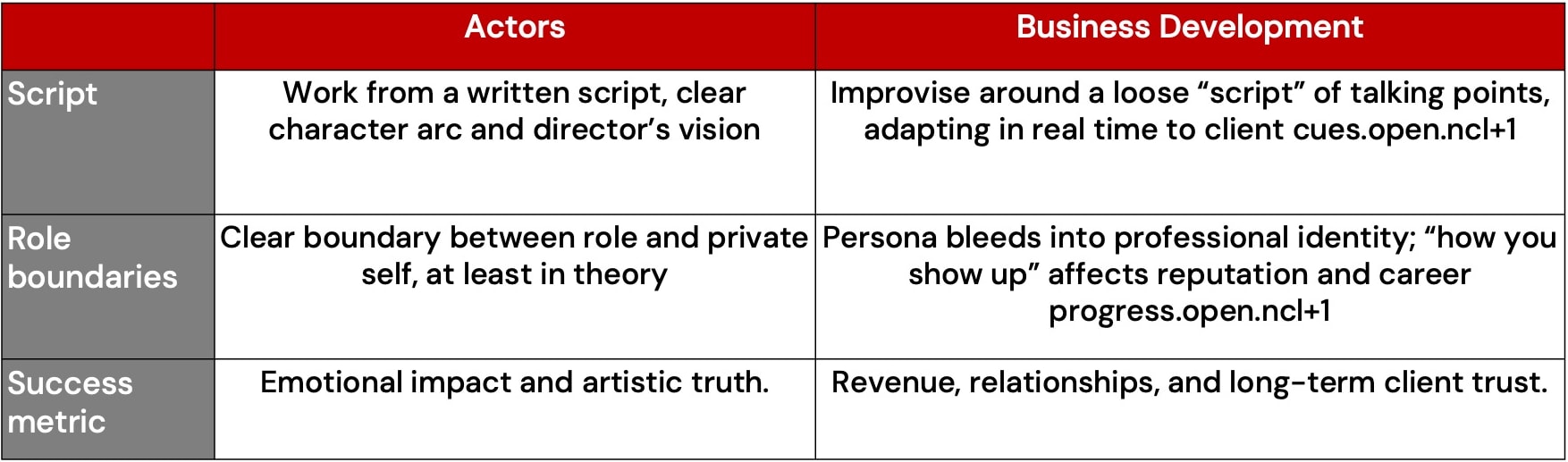
Both actors and business development professionals engage in this kind of performance, carefully curating their persona to win attention, trust and ultimately a desired outcome.
And when it comes to emotional labour, again, there’s a lot in common. Psychologists describe emotional labour as managing feelings and expressions to fulfil a job role – smiling, staying upbeat or projecting calm even when you don’t feel that way. Research on business development and B2B roles shows that this kind of ‘surface acting’ can boost performance but, if overused, harms wellbeing and job satisfaction, echoing the strain performers feel when their on-stage self diverges from their inner state.
Or put another way, putting on a mask that doesn’t quite fit, leading to disappointment, burnout and reduced job satisfaction. Goffman noted that maintaining a performance that clashes with reality invites ‘disruptions’, and business development professionals feel this when the polished persona in the room doesn’t match what can be delivered.
To avoid this and have a meaningful, successful and sustainable business development role, the evidence points towards having performances that rely on ‘deep acting”: aligning inner attitudes with the outward role so the persona is an amplified but honest version of the self.
For business development, that means treating meetings, events, pitches, networking and the like, less as a mask to wear, and more as a crafted but authentic role – know your character, rehearse your lines, but let genuine curiosity and empathy drive the scene.
At Spring CC, I have a breadth of personalities in the business development team, each one drawn with different experiences, cultures and expertise. This is no accident, it’s a deliberate ploy – to have a variety of inputs, to get better outputs. And we impress on each other that you need to be authentic versions of yourselves – we know how people buy – they buy people first – so let your personality shine through, don’t hide parts of your character and personality thinking that this will help the end goal – it ultimately won’t as you cannot sustain it for ever.
Every day is a school day they say. Although I’ve been in business development for over 15 years, it is still inspiring to hear from clients and how they see things from their side. One recent comment, which is as true now as it has always been, was that “we need to get to know you guys first, understand what drives you, your values, culture. That is important to us. We can get to the capabilities, models, case studies and the like later, but in the first instance, we need to know that we can work together. When we’re in the trenches and facing issues, are you going to be with us?”
An important lesson we all need to be reminded of. No acting.
TLDR version:
Actors and business developers both perform for an audience, using front‑stage personas, scripts and emotional labour to win attention and trust. Drawing on Goffman’s idea that everyday life is theatre, the piece argues there’s no single “true” self, only roles we play in context. Problems arise when the BD persona becomes an ill‑fitting mask, causing burnout. Sustainable success comes from “deep acting”: an authentic, well‑rehearsed version of yourself that clients can genuinely get to know and rely on.
(This article is also published on Austen Donnellans LinkedIn profile)

Austen Donnellan
Head of Growth






WHAT WE DO
OUR WORK
ABOUT US
ABOUT US
GET IN TOUCH →
Are we all just acting?
Following on from the movie awards season, and coinciding with several events, pitches and conferences for myself, I was struck by the thought that much of the behaviours in business development share similarities with acting.
Both actors and business developers consciously shape how they are seen, drawing on the same underlying dynamics of performance, impression management and emotional labour.
Taking a lead from the phrase ‘All the world’s a stage’ you can easily swap a stage for a pitch presentation, a movie scene for an introductory client call, or a pre shoot read through for a business planning meeting.
It was Erving Goffman, sociologist, social psychologist and writer who coined the phrase ‘everyday life is theatre’ back in the 1950s. He promoted the view that people perform roles for specific audiences, using scripts, costumes and settings to manage how others perceive you, avoid embarrassment and make a positive impression. He went even further, drawing from the world of acting to break the theory down into:
- Front Stage: the place where individuals perform, adhering to conventions and roles (e.g at work) for an audience.
- Backstage: the private area where individuals step out of character, relax, and prepare for future front-stage performances.
- Impression Management: the conscious or subconscious, and often calculated effort to control the image others form of us.
- Social Scripts/Roles: Standardised behaviours and lines that guide interaction, like acting in a play.
- Definition of the Situation: The shared understanding of what is happening, essential for social cohesion
So, in short, Goffman argues that there is no single ‘true’ self; instead, identity is a collection of roles performed depending on context. The ‘self’ is a social product created through these performances.
Both actors and business development professionals engage in this kind of performance, carefully curating their persona to win attention, trust and ultimately a desired outcome.
And when it comes to emotional labour, again, there’s a lot in common. Psychologists describe emotional labour as managing feelings and expressions to fulfil a job role – smiling, staying upbeat or projecting calm even when you don’t feel that way. Research on business development and B2B roles shows that this kind of ‘surface acting’ can boost performance but, if overused, harms wellbeing and job satisfaction, echoing the strain performers feel when their on-stage self diverges from their inner state.
Or put another way, putting on a mask that doesn’t quite fit, leading to disappointment, burnout and reduced job satisfaction. Goffman noted that maintaining a performance that clashes with reality invites ‘disruptions’, and business development professionals feel this when the polished persona in the room doesn’t match what can be delivered.
To avoid this and have a meaningful, successful and sustainable business development role, the evidence points towards having performances that rely on ‘deep acting”: aligning inner attitudes with the outward role so the persona is an amplified but honest version of the self.
For business development, that means treating meetings, events, pitches, networking and the like, less as a mask to wear, and more as a crafted but authentic role – know your character, rehearse your lines, but let genuine curiosity and empathy drive the scene.
At Spring CC, I have a breadth of personalities in the business development team, each one drawn with different experiences, cultures and expertise. This is no accident, it’s a deliberate ploy – to have a variety of inputs, to get better outputs. And we impress on each other that you need to be authentic versions of yourselves – we know how people buy – they buy people first – so let your personality shine through, don’t hide parts of your character and personality thinking that this will help the end goal – it ultimately won’t as you cannot sustain it for ever.
Every day is a school day they say. Although I’ve been in business development for over 15 years, it is still inspiring to hear from clients and how they see things from their side. One recent comment, which is as true now as it has always been, was that “we need to get to know you guys first, understand what drives you, your values, culture. That is important to us. We can get to the capabilities, models, case studies and the like later, but in the first instance, we need to know that we can work together. When we’re in the trenches and facing issues, are you going to be with us?”
An important lesson we all need to be reminded of. No acting.
TLDR version:
Actors and business developers both perform for an audience, using front‑stage personas, scripts and emotional labour to win attention and trust. Drawing on Goffman’s idea that everyday life is theatre, the piece argues there’s no single “true” self, only roles we play in context. Problems arise when the BD persona becomes an ill‑fitting mask, causing burnout. Sustainable success comes from “deep acting”: an authentic, well‑rehearsed version of yourself that clients can genuinely get to know and rely on.
(This article is also published on Austen Donnellans LinkedIn profile)
Austen Donnellan
Head of Growth


WHAT WE DO
OUR WORK
ABOUT US
ABOUT US
GET IN TOUCH →
Are we all just acting?
Following on from the movie awards season, and coinciding with several events, pitches and conferences for myself, I was struck by the thought that much of the behaviours in business development share similarities with acting.
Both actors and business developers consciously shape how they are seen, drawing on the same underlying dynamics of performance, impression management and emotional labour.
Taking a lead from the phrase ‘All the world’s a stage’ you can easily swap a stage for a pitch presentation, a movie scene for an introductory client call, or a pre shoot read through for a business planning meeting.
It was Erving Goffman, sociologist, social psychologist and writer who coined the phrase ‘everyday life is theatre’ back in the 1950s. He promoted the view that people perform roles for specific audiences, using scripts, costumes and settings to manage how others perceive you, avoid embarrassment and make a positive impression. He went even further, drawing from the world of acting to break the theory down into:
- Front Stage: the place where individuals perform, adhering to conventions and roles (e.g at work) for an audience.
- Backstage: the private area where individuals step out of character, relax, and prepare for future front-stage performances.
- Impression Management: the conscious or subconscious, and often calculated effort to control the image others form of us.
- Social Scripts/Roles: Standardised behaviours and lines that guide interaction, like acting in a play.
- Definition of the Situation: The shared understanding of what is happening, essential for social cohesion
So, in short, Goffman argues that there is no single ‘true’ self; instead, identity is a collection of roles performed depending on context. The ‘self’ is a social product created through these performances.
Both actors and business development professionals engage in this kind of performance, carefully curating their persona to win attention, trust and ultimately a desired outcome.
And when it comes to emotional labour, again, there’s a lot in common. Psychologists describe emotional labour as managing feelings and expressions to fulfil a job role – smiling, staying upbeat or projecting calm even when you don’t feel that way. Research on business development and B2B roles shows that this kind of ‘surface acting’ can boost performance but, if overused, harms wellbeing and job satisfaction, echoing the strain performers feel when their on-stage self diverges from their inner state.
Or put another way, putting on a mask that doesn’t quite fit, leading to disappointment, burnout and reduced job satisfaction. Goffman noted that maintaining a performance that clashes with reality invites ‘disruptions’, and business development professionals feel this when the polished persona in the room doesn’t match what can be delivered.
To avoid this and have a meaningful, successful and sustainable business development role, the evidence points towards having performances that rely on ‘deep acting”: aligning inner attitudes with the outward role so the persona is an amplified but honest version of the self.
For business development, that means treating meetings, events, pitches, networking and the like, less as a mask to wear, and more as a crafted but authentic role – know your character, rehearse your lines, but let genuine curiosity and empathy drive the scene.
At Spring CC, I have a breadth of personalities in the business development team, each one drawn with different experiences, cultures and expertise. This is no accident, it’s a deliberate ploy – to have a variety of inputs, to get better outputs. And we impress on each other that you need to be authentic versions of yourselves – we know how people buy – they buy people first – so let your personality shine through, don’t hide parts of your character and personality thinking that this will help the end goal – it ultimately won’t as you cannot sustain it for ever.
Every day is a school day they say. Although I’ve been in business development for over 15 years, it is still inspiring to hear from clients and how they see things from their side. One recent comment, which is as true now as it has always been, was that “we need to get to know you guys first, understand what drives you, your values, culture. That is important to us. We can get to the capabilities, models, case studies and the like later, but in the first instance, we need to know that we can work together. When we’re in the trenches and facing issues, are you going to be with us?”
An important lesson we all need to be reminded of. No acting.
TLDR version:
Actors and business developers both perform for an audience, using front‑stage personas, scripts and emotional labour to win attention and trust. Drawing on Goffman’s idea that everyday life is theatre, the piece argues there’s no single “true” self, only roles we play in context. Problems arise when the BD persona becomes an ill‑fitting mask, causing burnout. Sustainable success comes from “deep acting”: an authentic, well‑rehearsed version of yourself that clients can genuinely get to know and rely on.
(This article is also published on Austen Donnellans LinkedIn profile)
Austen Donnellan
Head of Growth


General enquiries
hello@spring-cc.com
Copyright 2025 Spring CC. All Rights Reserved.